


 Locations

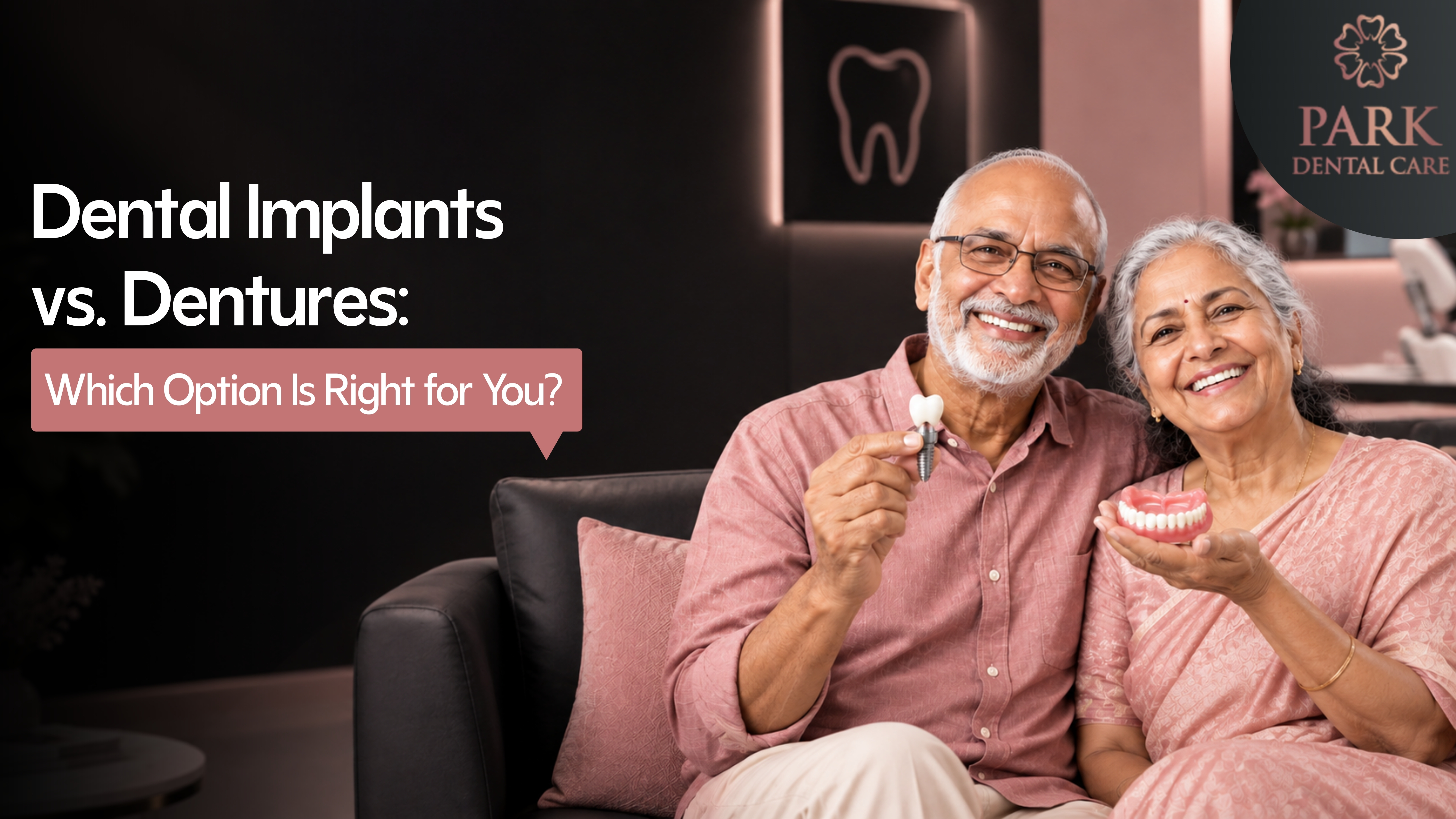
Dental Implants vs. Dentures: Which Option Is Right for You? - Park Dental Care
Missing teeth can affect more than just your smile. They can make chewing difficult, affect speech, change the way your face looks, and sometimes impact your confidence. Fortunately, modern dentistry offers several ways to replace missing teeth. Two commonly considered options are dental implants and dentures.
Both treatments can restore missing teeth, but they work differently and have different advantages, limitations, costs, and maintenance requirements. If you are considering dental implants in Hyderabad or dentures in Hyderabad, understanding these differences can help you have a more informed discussion with your dentist.
At Park Dental Care, treatment options are selected based on individual oral health, the number of missing teeth, bone condition, lifestyle, and long-term dental goals.
What Are Dental Implants?
Dental implants are artificial tooth roots that are placed into the jawbone. Once the implant has integrated with the surrounding bone, it can support a dental crown, bridge, or implant-supported denture.
A typical implant restoration consists of three main components:
- Implant: A small post placed into the jawbone.
- Abutment: A connector attached to the implant.
- Crown or prosthesis: The visible replacement tooth or teeth.
Because implants are anchored in the jaw, they can provide a stable foundation for replacement teeth.
What Are Dentures?
Dentures are removable dental appliances designed to replace missing teeth and surrounding oral tissues. They can replace several missing teeth or an entire arch of teeth.
Depending on the patient's needs, dentures may be:
- Complete dentures: Replace all teeth in an upper or lower arch.
- Partial dentures: Replace several missing teeth while some natural teeth remain.
- Implant-supported dentures: Use dental implants to provide additional support for a removable denture.
Dentures are custom-made to fit the patient's mouth and restore essential functions such as chewing and speaking.
Dental Implants vs. Dentures: Key Differences
While both options can replace missing teeth, they differ in how they function and how they are maintained.
| Feature | Dental Implants | Dentures |
|---|---|---|
| Support | Anchored to the jawbone | Rests on the gums or uses remaining teeth |
| Removable | Usually fixed once restored | Generally removable |
| Stability | Generally, provides strong stability | May move slightly during chewing or speaking |
| Treatment process | Requires surgical implant placement | Usually does not require implant surgery |
| Bone preservation | Helps provide stimulation to the jawbone | Does not provide the same stimulation |
| Maintenance | Requires regular brushing and professional dental care | Requires removal and cleaning |
| Treatment time | Usually longer | Often faster to provide |
| Initial cost | Generally higher | Generally, more affordable initially |
The right option depends on your individual circumstances rather than one treatment being universally better.
Advantages of Dental Implants
One of the main advantages of implants is their stability. Because the implant is placed within the jawbone, it can provide a strong foundation for a replacement tooth.
Dental Implants may be considered for patients who want a fixed solution for missing teeth.
Potential advantages include:
- Natural-looking appearance: Implant-supported restorations can be designed to resemble natural teeth.
- Improved chewing: A stable restoration can make eating more comfortable.
- Fixed replacement: Patients generally do not need to remove the implant-supported tooth for routine daily activities.
- Support for facial structure: Replacing missing teeth and their roots can help maintain the structure of the jawbone around the implant site.
- No reliance on neighbouring teeth: A single implant can replace an individual missing tooth without requiring conventional preparation of adjacent healthy teeth.
- Long-term solution: With appropriate treatment planning and maintenance, implants can provide long-lasting tooth replacement.
However, implant treatment requires adequate evaluation of the jawbone, gums, general oral health, and other factors.
Advantages of Dentures
Dentures remain an important tooth replacement option, particularly for patients with extensive tooth loss or those who may not be suitable candidates for implant treatment.
Some advantages include:
- Removable design: Dentures can be taken out for cleaning and maintenance.
- Replacement of multiple teeth: A single appliance can replace several missing teeth.
- Full-arch rehabilitation: Complete dentures can restore an entire arch when all natural teeth are missing.
- Generally lower initial cost: Dentures may have a lower upfront cost compared with implant treatment.
- No implant surgery: Conventional dentures do not require surgical placement of implants.
For many patients, dentures can provide meaningful improvement in chewing, speech, appearance, and confidence.
Which Is Better for You: Dental Implants or Dentures?
There is no single solution that is suitable for every patient. Your choice should be based on your oral health, expectations, budget, and long-term treatment goals.
Dental implants may be considered when:
- You want a fixed tooth replacement option.
- You have adequate bone and healthy oral tissues for implant treatment.
- You are prepared for a treatment process that includes healing.
- You want a solution that closely replicates the function of a natural tooth.
- You are looking for a long-term tooth replacement approach.
Dentures may be considered when:
- You need to replace several or all missing teeth.
- You prefer a removable restoration.
- You are looking for a more economical initial treatment option.
- Implant placement is not suitable or is not currently preferred.
- You want to restore your smile without implant surgery.
In some cases, patients may also benefit from implant-supported dentures, which combine implants with a removable or fixed prosthetic restoration. This can provide additional stability compared with conventional dentures.
Factors to Consider Before Choosing a Tooth Replacement
Before deciding between implants and dentures, several factors should be evaluated.
1. Jawbone Health
Dental implants require sufficient bone to provide support. If significant bone loss has occurred following tooth loss, additional procedures may sometimes be considered before or alongside implant treatment.
2. Gum Health
Healthy gums are important for successful tooth replacement. Existing gum disease should be evaluated and managed appropriately.
3. Number of Missing Teeth
A single missing tooth may be treated differently from complete tooth loss. The number and location of missing teeth influence the available treatment options.
4. Jawbone Condition
Dental implants require sufficient bone to provide support. If there has been significant bone loss, additional procedures may sometimes be considered before implant placement.
5. Overall Oral Health
Cavities, infections, gum disease, and other dental conditions may need to be addressed before proceeding with definitive tooth replacement.
6. Lifestyle and Expectations
Some patients prioritise a fixed restoration, while others prefer the convenience and flexibility of a removable appliance. Understanding these preferences helps guide treatment planning.
7. Budget
The initial cost of dentures and implants can differ considerably. However, patients should also consider maintenance, replacement, longevity, and the overall treatment process when discussing costs with their dentist.
How to Maintain Your Replacement Teeth
Regardless of whether you choose implants or dentures, proper maintenance is essential.
For dental implants:
- Brush twice daily.
- Clean between teeth and around the implant.
- Attend regular dental check-ups.
- Follow your dentist's maintenance recommendations.
- Address gum inflammation or discomfort promptly.
For dentures:
- Remove and clean them as instructed.
- Maintain good oral hygiene even when wearing dentures.
- Store dentures appropriately when they are not being worn.
- Attend dental check-ups to evaluate fit and oral health.
- Have dentures adjusted or replaced when necessary.
Why Choose Park Dental Care in Hyderabad?
Whether you're considering dental implants in Hyderabad or dentures in Hyderabad , Park Dental Care offers expert guidance and personalized treatment.
What Sets Us Apart:
- Experienced Specialists: Our team is highly skilled in both implantology and prosthodontics, ensuring precise and successful outcomes.
- Advanced Technology: We use 3D imaging, digital impressions, and precision planning to deliver accurate and comfortable treatments.
- Patient‑Centric Care: Every solution is customized to match your lifestyle, oral health needs, and long‑term goals.
- Convenient Locations: With clinics in Jubilee Hills and Kondapur, accessing quality dental care is simple and hassle‑free.
- Proven Results: We have completed hundreds of successful implant and denture cases, building trust and confidence among our patients.